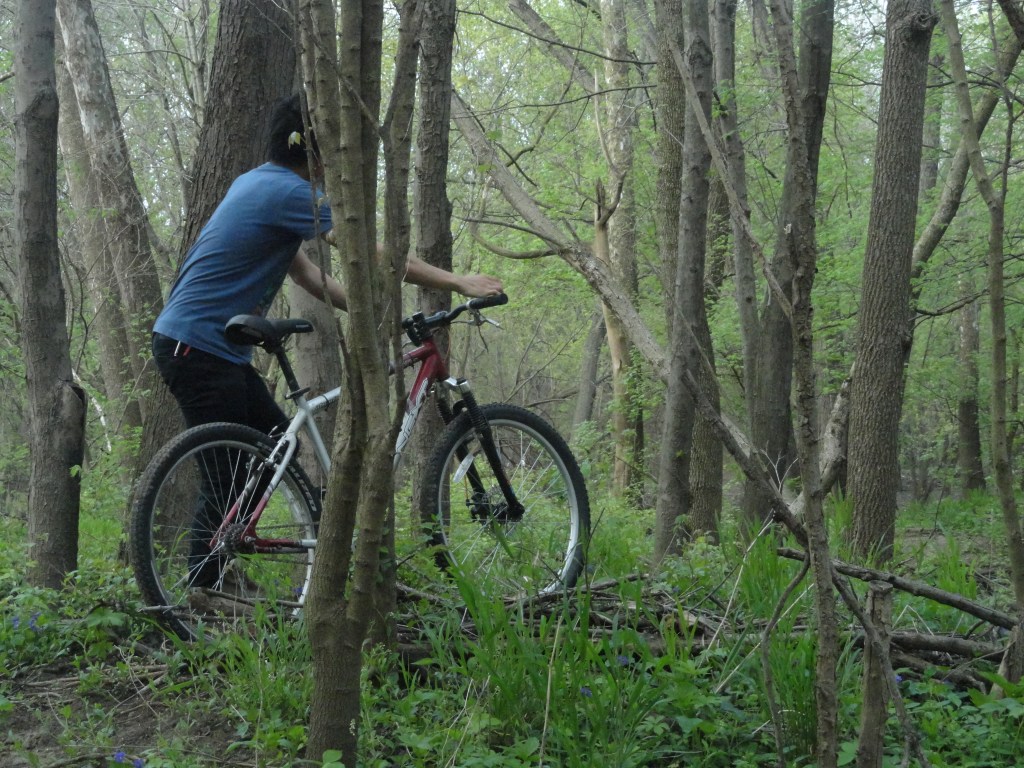
A solo project exploring and improving how new cyclists pick a bicycle to suit their needs.
Background
This project was addressing something that had been irking me since I got into cycling, the disconnect between bike shops/ bike industry and the customers they serve. I worked at Performance Bicycle, a bike shop in Indianapolis, in the Summer of 2018, and this is what truly opened my eyes to this divide.
Most people who want to buy a bike are not avid cyclists, they just want something fun and easy to ride. They do not know all the different genre’s of bikes, what separates then, how a head angle effects their bike, or anything that the industry really advertises. This leads them to go somewhere bikes are talked about in their language, a big box store like target or Walmart, which focus on adding things to make they bike sell, while taking away qualities that complete a reliable and trustworthy bike to keep the cost down.
This is not the customer’s fault, but many in the bike industry seem to think it is, so I got to researching how exactly these more causal consumers think and what I can do to make sure they get a bike they truly want.
Scope
There is a lot in the bike industry I could look at, so I wanted to keep things focused, especially because this was a solo project.
I decided to focus on researching how customers think of bikes, both ones ridden in the past and ones they are looking to purchase. Do they see individual parts and components, or do they view the bike as one whole object? Are their memories of how a bike rides framed by emotion or the simple mechanics of the two-wheeled vehicle? How has their past experience’s with bicycles shaped what they look for in a new bike, and is this reading accurate to the bike actual proprieties and capabilities? I set out to answer these questions through interviews, activities, as well as a contextual inquiry.
Primary Research
For research, I gathered contacts of friends and family who were either not cyclist, or casual ones looking to get deeper into it. But, I needed a baseline, someone who new a lot about bikes and had worked in the industry to compare what knowledge they had versus the assumptions the customers made. With the COVID-19 pandemic going on during this time period, I did not want to go to a public bike shop for an extended amount of time to ask a busy owner questions, so I just used myself as this baseline. I used my knowledge to create some activities and interview protocols to get the best info out of the users I researched.
Bike Comparison Interview
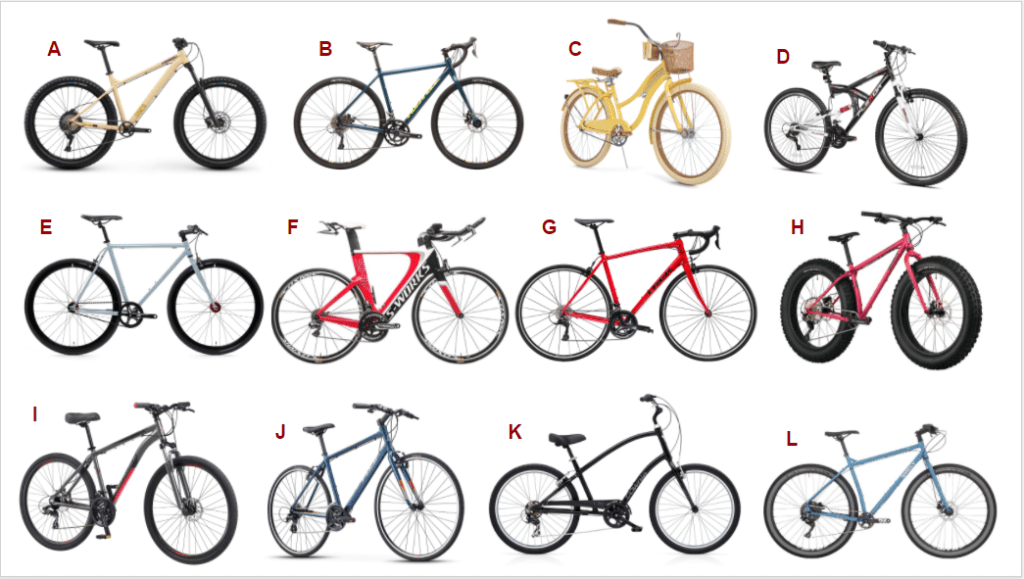
I wanted to create an engaging interview to see what people thought of a variety of bikes, so i created a collage of 12 bikes for users to look at. I gave them some time to look at them, and asked them a variety of questions about what type of bike each one was, which might be the fastest or the most capable offload, and asking them to estimate some of thier costs. I also asked them what bike they would choose for themselves,. and what they would do with said bike.
This activity gave me a lot of info on how a casual customer see’s a potential new bike, and how they interpret the different aspects and parts of one. For example, a couple users thought bike F would be the heaviest because it has so much frame, but in truth it would be the lightest because all that frame is carbon fiber.
Past Bike Interview
This was a simple and short interview where I asked users about their past bikes and what they thought of them. I first asked for basic info about to bike to see if I could identify it myself, which allowed me to compare how they talked about it versus what I knew about the bike. I then asked them about the bike itself. They described to me how the bike tackled different terrain, where they rode it, and how riding this particular bike made them feel. I further asked what genre of bike would they would describe it as and if they could remember what types of parts it had on it. This allowed me to see how they internalized the riding aspects of a bicycle as well as if they could accurately identity parts of a bicycle that would affect this.
Contextual Inquiry
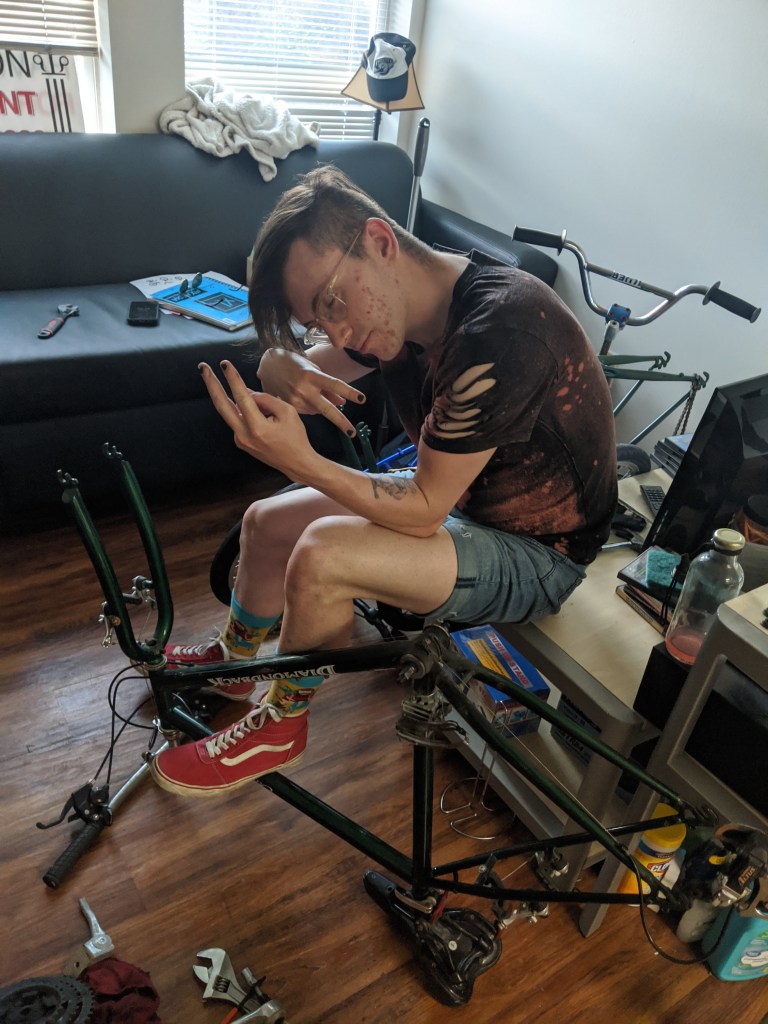
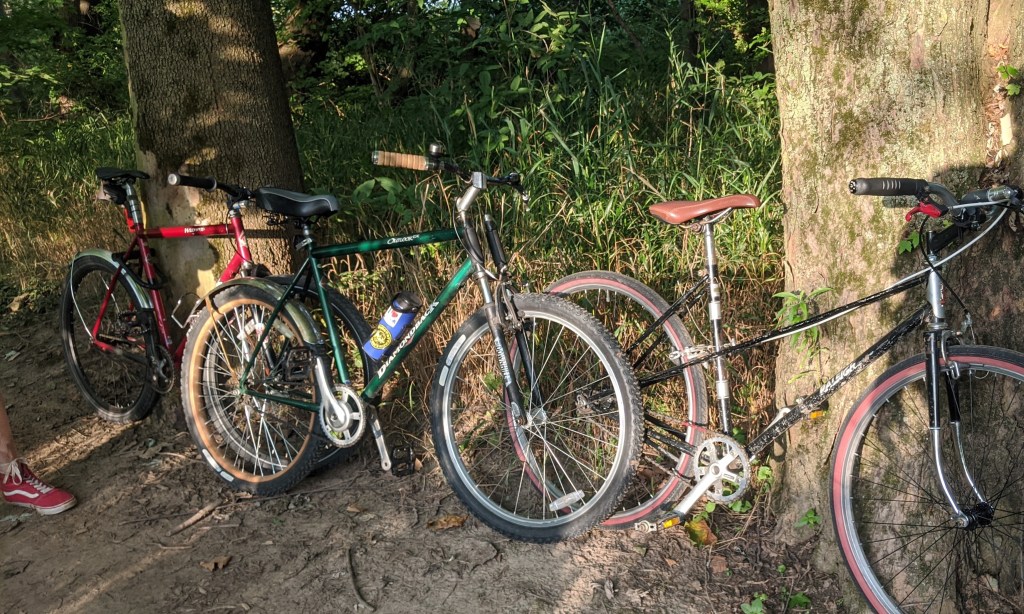
For a contextual inquiry I got into the head of my friend Matt as I built a custom commuter bicycle out of scrap parts for him. I am no stranger to building bikes for friends & acquaintances, so building a bike for my friend Matt and calling it research might seem like a stretch, but I made sure I got legitimate insights from this process. To start, before I got to building I put him through the Bike Comparison Interview and I took a lot of notes during the planing and building process.
We ended up with a bike that was very similar to my own, but Matt was very happy with it and he has been riding with me and other friends with it often, as well as getting to class with it. We had put a lot of thought into the bike itself, which both gave me great insights into how a college student new to biking like Matt interprets different aspects of a bike, as well as a great vehicle to get him around with.
Major Insights
There were a lot of insights to gather from my primary research, with 2 different interviews that got info from a lot of people and a lengthy contextual inquiry, but there were a few that stood out as being able to effect a future design that could help close the divide between bicycle customer and bicycle seller.
- Most casual bikers had very limited knowledge about different Bicycle Disciplines/”Genres”.
- Typically only knew about mountain bikes, road bikes, and something in between.
- Different customers (and even different industry professionals) had conflicting thoughts on what bikes belonged in what discipline.
- Focusing on a bike’s discipline would not help a customer pick the right bike for them.
- Casual bikers mostly did not focus on individual parts and how those parts effected the ride
- The focus was instead on the bike as a whole, instead of whether it had a suspension fork, a 1x drive train, etc.
- Exceptions: The seat. A lot of attention was given to the seat to decide the comfort of the bike in the user’s mind. Brakes as well were an exception, mostly a distinction between hand-pull brakes and pedal (coaster) brakes.
- Breaking down a bike by it’s parts would make the bike more focused in on the user’s biking need, but the user would be lost if this approach was taken.
- User’s defined a bike’s ride and qualities not by the emotions they felt riding, but psychical feelings and where and over what terrain they rode it.
- One often remembered aspect was the bike’s issues (bad shifting) and not it’s strengths.
- Things like color and the look of bike were often remembered.
- Adjectives like “squirrely” or “tanky” did not apply to their thoughts of the bike, but instead more vague adjectives like “fast”, “clunky,” or “comfortable.”
- A design would have to focus in on some parts of the bike, but be broad in others.
Next Steps
My planned next steps are to take these research insights and turn this project from a research project into a full on UX project. I want to create an experience where a customer does not have to interact with impatient and opinionated bike shop employees, or uncaring big box store employee’s, and instead have a digital experience that pairs them with a a bike right for their skill level, price point, terrain, and overall needs. Some ideas I have had so far are:
-A buzzfeed quiz like experience (but MUCH more interactive) to spit out a bike right for them
-A bike builder that would allow them to add aspects (not parts) onto a bike, and then present a bike as close as possible to that imaginary bike.
-An encyclopedia of bike disciplines and parts paired with an in depth bike builder that would educate user on the over complicated bicycle industry as they created a bike perfect for them
Whatever design I go with, I plan to create a lo-fi prototype and test that with someone by building them a bike based off the prototype, and then taking the insights from that to a mid-fi digital prototype which I will also test in much the same way.
 Benjamin's portfolio